Vienna-area property owners face higher costs for trash disposal after supervisors acknowledged Monday that reserve funds propping up the system will be gone within a year.
Hunter Mill District Supervisor Walter Alcorn, who represents Vienna, voiced frustration at the Board of Supervisors' Environmental Committee meeting that the problem wasn't addressed sooner.
"My big frustration is we didn't have this conversation three or four years ago," Alcorn said.
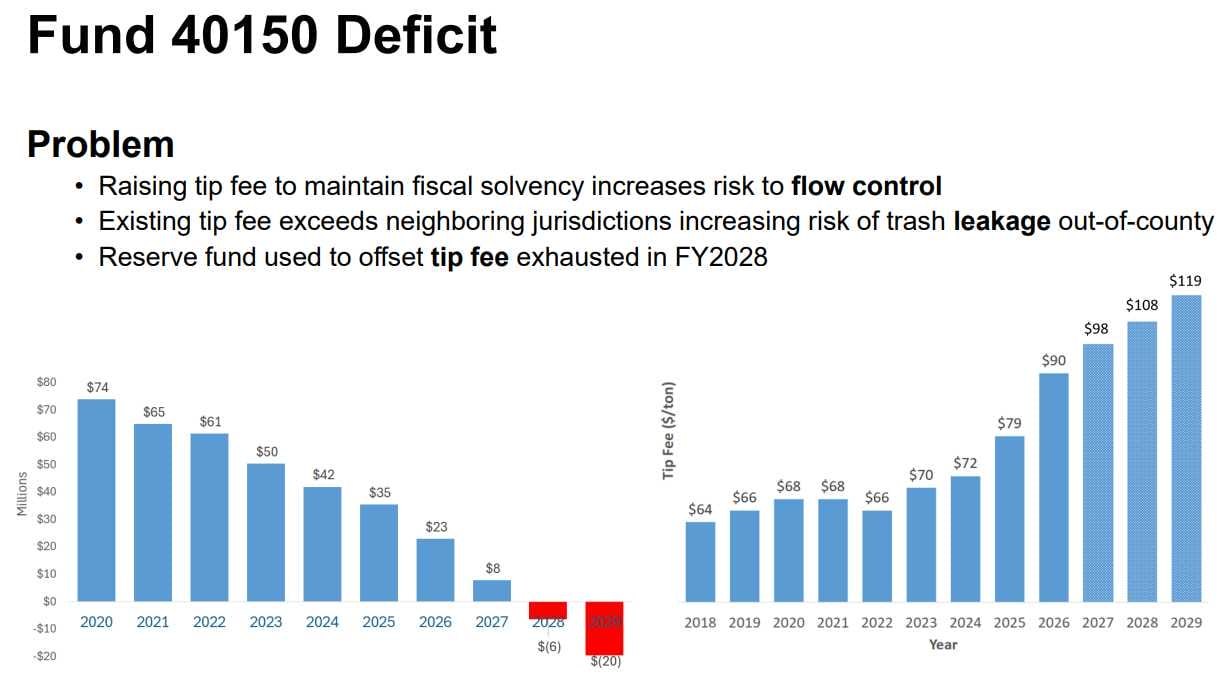
The county's solid waste reserve fund has plummeted from roughly $74 million in 2020 to near zero, according to a staff chart presented at the meeting. Staff project it will be fully depleted by June 30, 2027. Starting in fiscal year 2028, the "tipping fees" haulers pay to dump trash at county facilities won't cover operating costs, even though Fairfax already charges $90 per ton, the highest rate among comparable local jurisdictions.
For context: Prince William County charges $40 per ton, Loudoun charges $78, and Arlington charges residential customers nothing.
What it means for residents
About 90% of Fairfax County households hire private trash haulers, either individually or through their homeowners association. Those haulers are required by county rules to use county facilities. If fees rise further, haulers would pass the cost to customers.
County Executive Bryan Hill, who will begin developing the fiscal year 2028 budget proposal this fall, said a General Fund subsidy remains on the table but acknowledged the county's tight fiscal position. Christopher Herrington, director of the Department of Public Works and Environmental Services, said staff have identified ways to cover an anticipated $6 million shortfall for FY2028 but warned there is "no silver bullet" for the long term.
Options on the table
Staff presented several revenue options at the Tuesday meeting, according to the county's official presentation:
- A "sustainability fee" averaging about $60 per household annually, applied to all property owners regardless of whether they use county collection. Supervisors rejected this proposal in May 2026 but may revisit it.
- A General Fund subsidy using property tax revenue.
- Increasing the plastic bag tax (estimated $1 million gain).
- Corporate sponsorships and advertising on trash trucks (estimated $1 million gain).
On the cost-cutting side, staff proposed a one-year freeze on non-mandatory capital improvement projects, saving an estimated $5 million, and eliminating contract hauling to save roughly $4 million.
Staff classified more dramatic options, including abandoning the county's flow-control mandate and shutting down the I-66 Transfer Station, as "not feasible."
The political backdrop
Every supervisor faces voters in 2027. Dranesville District Supervisor Jimmy Bierman urged staff to bundle all options into a single package for the board to consider. Providence District Supervisor Dalia Palchik, who chairs the Environmental Committee, said she would be open to revisiting the previously shelved unified sanitation district concept, though state law would require five years' notice to displaced haulers.
About 600,000 tons of trash per year move through the county system, traveling from the I-66 Transfer Station to the Reworld Fairfax facility in Lorton. Each county resident produces roughly one ton of trash annually, according to county data.
.jpeg)